
'So far our production is not affected. But every day the situation prolongs, it does bring risks in terms of shipments getting delayed.'

Suzuki Motorcycle India Ltd (SMIPL) has revised its domestic two-wheeler sales growth estimate for FY27 downwards from 7-8 per cent, citing rising commodity costs due to the ongoing West Asia conflict and its impact on consumer affordability.

Bajaj Auto is planning a slow, calibrated push to take the Chetak, its electric scooter, to more than 100 countries on the strength of its distributor network and market-specific localisation rather than an aggressive global rollout, reports Sohini Das.

Indian equity markets closed higher, driven by gains in PSU bank, auto, and financial stocks, following the US Supreme Court's decision on tariffs. Sensex climbed 479.95 points to 83,294.66, and Nifty advanced 141.75 points to 25,713.

Do not exit in panic or buy falling stocks without reassessing fundamentals; instead, build a watchlist and invest gradually with a disciplined, long-term approach.

Following a Supreme Court setback, Donald Trump has announced an increase in global tariffs from 10% to 15%, impacting international trade relations and raising concerns about economic repercussions.

The cost of the war is being counted not in the corridors of power in Washington or Tehran, but in Firozabad's darkened furnace rooms, Howrah's idle casting sheds, and a barbershop in Kochi where the wait is suddenly, inexplicably, an hour long, notes Prem Panicker in his must read blog on the Iran War.

After a record-breaking year, India's automobile industry is entering 2026 on a relatively strong footing, with sales growth expected in the 6-8 per cent range. The outlook is underpinned by policy support, including GST rationalisation, easing monetary conditions, and income tax relief, which together are likely to improve affordability and sustain consumer demand across vehicle segments.

India and the US have entered a new phase in their relationship, marked by greater parity, point out Harsh V Pant and Vivek Mishra.

'The next phase of India's IPO cycle will be defined by quality, pricing discipline and investor selectivity.'

Czech carmaker Skoda plans to bring more of its global nameplates into the Indian market as it looks to cater to a diverse set of customers, according to a senior company executive. The company, which now sells products in India ranging from over Rs 7 lakh to upwards of Rs 40 lakh, however, has no immediate plans to introduce electric cars in the country.

Finance Minister Nirmala Sitharaman's biggest challenge will be to find a new growth driver, particularly against the backdrop of a global economy ravaged by heightened uncertainty and fragmentation, financial markets on a precipice, and global commodity prices on a continued uptrend.

The fiscal tilt towards capex benefits companies in investment-related sectors like capital goods, defence equipment, engineering & construction and metal & mining. The planned cut in revenue expenditure will weigh on companies in consumption sectors like FMCG, consumer durables and retail.

Six months after its India debut, the Vietnamese automaker has overtaken established players such as Hyundai Motor, BMW, Kia, and Chinese EV major BYD.

India has been on an FTA-signing spree of late. Since 2021, it has signed eight trade agreements, three of which -- with the UK, Oman and New Zealand -- were finalised in 2025 alone.

After two years of strong gains, smallcap stocks fell sharply in 2025, but the correction may be setting up opportunities for long-term investors.
Auto parts exports from India may see a slight slowdown as US President Donald Trump's 25 per cent tariff could increase car prices for buyers by 8-25 per cent, thereby affecting demand, experts believe.

'We serve more than 1.2 billion trips annually and have over 1.5 million active earners each month using the platform.'

It is a marketplace of attention, where legacy publishers, global franchises, and consumer brands meet to make the most of India's expanding fandom economy.

Key benchmark indices Sensex and Nifty declined for the third session in a row on Friday, dropping nearly 1 per cent, dragged by heavy selling in IT, auto and energy stocks. Tariff-related uncertainties amid mixed global market trends also added to the pressure, analysts said. The 30-share BSE Sensex tanked 689.81 points or 0.83 per cent to settle at 82,500.47.

Yamaha expects its first EVs to hit showrooms by the last quarter of FY26 (January - March), once network readiness is complete.

A deep split has emerged within India's auto industry over the proposed CAFE exemption for small cars, with only Maruti Suzuki and Renault backing the move in the final SIAM vote.

South Korean auto major Hyundai Motor Co president & CEO Jose Munoz on Wednesday said the company's Indian arm will invest Rs 45,000 crore by FY30, aiming to make India its second-largest region globally. Addressing investors here in his first visit to the country, Munoz said Hyundai Motor India Ltd (HMIL) has set a target of up to 30 per cent export contribution.

Almost 30 per cent of Maruti's auto-component exports are to the US, and about half of that is facing a duty of 25 per cent and the other half 50 per cent.

Among Sensex firms, Tata Motors rose the most by 3.97 per cent. Mahindra & Mahindra jumped by 3.96 per cent. Maruti, Adani Ports, Bajaj Finance and UltraTech Cement were also among the gainers. However, Trent declined 3.81 per cent. Asian Paints, HCL Tech, Tech Mahindra, L&T, TCS, Power Grid and Sun Pharma were also among the laggards.

Maruti Suzuki will introduce eight SUVs over the next five years taking its overall model range to 28 as it aims to regain 50 per cent market share in the domestic passenger vehicle segment, Suzuki Motor Corporation Representative Director and President Toshihiro Suzuki said on Wednesday.

'Defence, capital goods, engineering, capital market-related stocks, autos, and cement sectors are my bullish bets for Samvat 2082.'

More than 40 new product launches are expected at the upcoming Auto Expo which will be held under the umbrella of Bharat Mobility Global Expo 2025 from January 17-22, a government official said on Tuesday. With visas continuing to be an issue, large scale participation of Chinese companies are unlikely although some of them are participating at the expo, Joint Secretary at Ministry of Commerce and Industry Vimal Anand said at the sidelines of curtain raiser of 'Bharat Battery Show' which will also be a part of the Bharat Mobility Global Expo 2025.
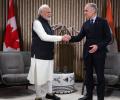
For Canada, important steps towards containing domestic elements that fuel pro-Khalistan sentiments can go a long way in signalling trust positively with regard to security and sovereignty, point out Harsh V Pant and Vivek Mishra.

'The frenzy for gold is primarily due to the uncertainty surrounding the tariff war.'

Equity benchmark indices Sensex and Nifty ended lower on Friday, dragged by auto stocks and relentless foreign fund outflows. Weak US markets and tariff threats also dented investor sentiment. The 30-share BSE benchmark Sensex dropped 424.90 points or 0.56 per cent to settle at 75,311.06.

Analysts believe Tesla will first focus on building the Model Y brand before expanding -- both in terms of volume and models.

Traversing from being just vehicle manufacturers to mobility solutions providers amid a raging debate over which eco-friendly technology must be incentivised, the Indian automobile industry is driving in the new year under the shadow of a slowdown in sales with the post-pandemic pent-up demand in distant memory. The shift in the auto industry -- where advanced technologies like autonomous driving, vehicle intelligence, connected features and electrification are quickly gaining traction -- will be reflected in the upcoming Bharat Mobility Global Expo in which India's flagship Auto Expo has been clubbed to be held from January 17-22, 2025 in Delhi-NCR.

In trade negotiations, as in chess, sometimes you need to accept a temporary disadvantage to secure a better long-term position, points out Sonal Varma, chief economist (India and Asia ex-Japan) at Nomura.

GST 2.0 may cushion consumers against US tariffs, but like the 2019 corporate tax cut, it risks being another tactical fix rather than a structural growth strategy, expects Debashis Basu.

Foreign brokerages remain cautious on the road ahead for the Indian equity markets. Though analysts at Nomura have revised their March 2026 Nifty target to 26,140 levels from the earlier 24,970, but the upside from the current levels is a modest 6 per cent. BofA Securities, on the other hand, has not made any change to its year-end Nifty target.

The proposed reforms in goods and services tax (GST) announced by the government last week, coupled with the eighth pay commission dole-out, is likely to push consumption-driven stocks - such as air conditioners (ACs), select automobiles, fast-moving consumer goods (FMCG), retail, and counters of quick-service restaurants (QSRs) - into higher orbit over the next few months, believe analysts.

'As long as Sebi maintains transparency and market stability, the Jane Street episode is unlikely to deter long-term foreign capital.'

SEBI's blockbuster reforms are rewriting the rules of mutual fund investing -- faster growth, sharper transparency, and smarter safeguards that put investors first, explains Ramalingam Kalirajan.

There's no change in Apple Inc's India strategy, said a top government source. 'It can only be enhanced'.
 © 2026 Rediff.com - Advertise with us - Disclaimer - Privacy Policy - Sitemap - Feedback - About us - Terms of use - Grievances